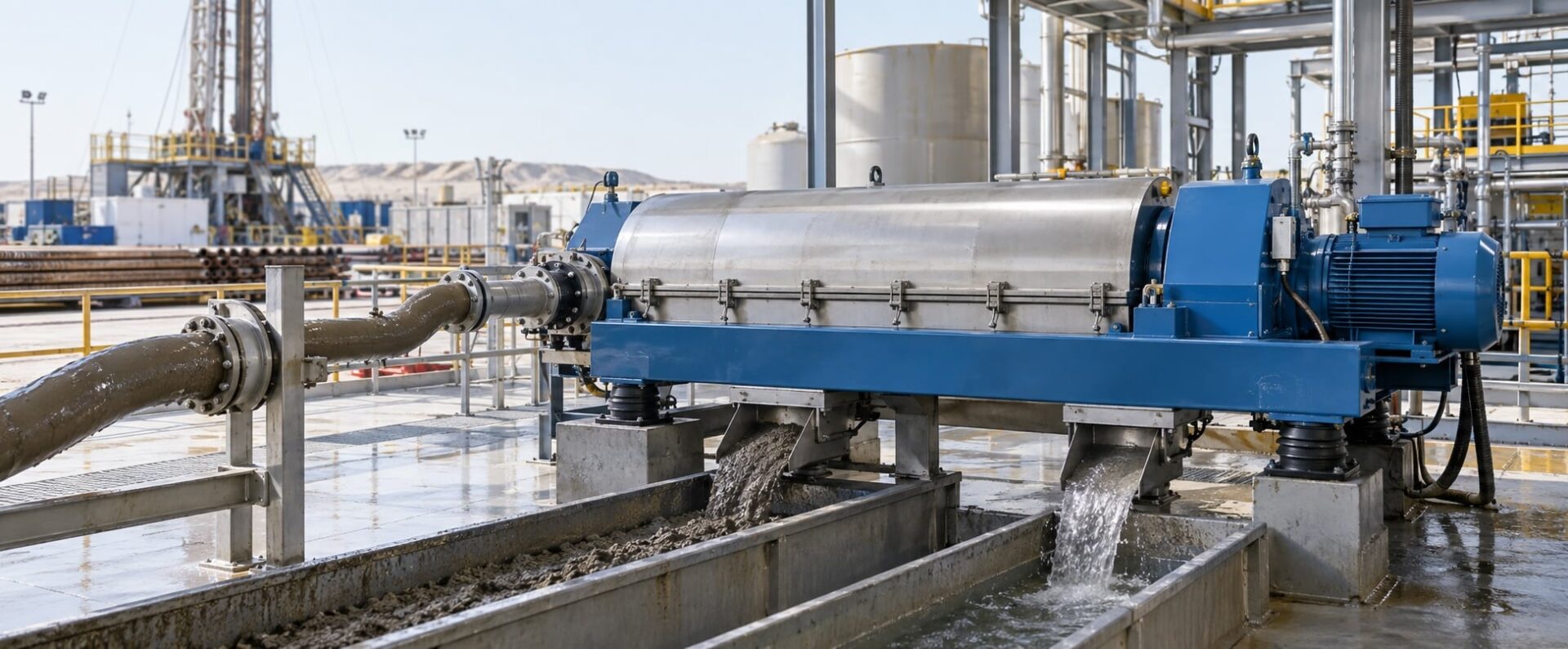
Solids control centrifuge performance depends on the relationship between feed mud, bowl speed, differential speed, liquid properties, solids loading, and the selected operating goal. A centrifuge should be evaluated as part of the full fluid system, with stable feed, clear discharge paths, correct maintenance, and verified separation results.
A centrifuge is a high-speed separation device used to remove selected fine solids from drilling fluids or to recover liquid from a solids stream. It works downstream of other equipment, so its performance depends on what the shale shaker, mud cleaner, tank system, and feed pump deliver to it. It cannot correct every upstream process problem by itself.
Within the solids control equipment system, the centrifuge provides a controlled stage for fine-solids separation. Its value comes from matching centrifuge mechanics to the current fluid, solids, and operating objective rather than running one fixed setting for every condition.
Key takeaways
- Feed condition, bowl speed, and differential speed work together.
- Separation efficiency changes with particle size, viscosity, solids loading, and feed rate.
- Stable feed and discharge routes are as important as the centrifuge settings.
- Use operating observations and maintenance records to make controlled adjustments.
Centrifuge Mechanics and the Separation Effect
A decanting centrifuge uses a rotating bowl and an internal conveyor to separate solids and liquid. As feed mud enters the bowl, centrifugal force moves denser particles outward while liquid forms an inner layer. The conveyor transports settled solids toward the solids discharge while clarified or conditioned liquid exits through the liquid end of the machine.
The physical effects inside a centrifuge are continuous. Rotational speed creates the centrifugal force that drives settling. Differential speed controls the relative movement between the bowl and conveyor, which affects residence time and the way settled material travels toward discharge. Pool depth, feed rate, and the properties of the drilling fluid also affect the separation effect.
What the centrifuge is separating
A centrifuge does not remove every particle in the same manner. Larger or denser particles may settle more readily than very fine particles. Particle size, density difference, liquid viscosity, solids concentration, and the amount of time material remains in the bowl all influence separation. The practical goal may be cleaner drilling fluid, lower fine-solids concentration, recovery of usable liquid, or a manageable solids discharge.
Feed Mud, Flow, and Pump Conditions
Feed mud is the starting point for centrifuge performance. The feed pump should supply a controlled, stable flow that matches the equipment and operating plan. Sudden changes in feed volume, air entry, restricted suction, poor tank mixing, or a change in drilling-fluid properties can affect the load inside the bowl and the resulting separation.
Review the tank supplying the centrifuge. The tank should provide suitable fluid, sufficient level, and a predictable suction condition. Settled solids, poor agitation, or uncontrolled transfer flow can create an inconsistent feed. A centrifuge may appear to have an efficiency problem when the actual issue is the feed system or an upstream process change.
Feed-condition checklist
- Confirm the feed tank level, suction condition, and fluid route.
- Inspect the feed pump, hoses, valves, fittings, and leak points.
- Observe feed rate changes and avoid uncontrolled surges.
- Note drilling-fluid properties, solids loading, and recent treatment changes.
- Verify that liquid and solids discharge have clear, controlled destinations.
Rotational Speed and Differential Speed
Rotational speed influences the centrifugal force available for solids separation. Increasing speed can change the settling conditions inside the bowl, but it also changes mechanical loading, power demand, wear, and the way the centrifuge responds to the feed. The correct speed depends on the equipment, fluid program, solids characteristics, and performance goals.
Differential speed affects how quickly the conveyor moves settled solids relative to the bowl. A change in differential speed can alter solids residence time, conveyance, discharge condition, and torque response. It should be adjusted through the equipment-specific controls and operating guidance, not used as a general shortcut for every solids-control problem.
Use controlled setting changes
Change one operating variable at a time when practical. Record the starting bowl speed, differential speed, feed condition, observed liquid, solids discharge, and result. This approach makes it easier to identify whether a change improved centrifuge performance or simply coincided with a change in drilling conditions or feed mud.
Viscosity, Particle Size, and Liquid Properties
Liquid viscosity affects how readily particles settle. A more viscous drilling fluid can change the settling speed of fine solids and alter the separation efficiency available at a given operating condition. Particle size matters as well: very fine particles may require more residence time or a different operating response than coarser solids.
Do not treat a centrifuge as a laboratory instrument disconnected from the rig. The feed may change with temperature, dilution, drilling rate, contamination, chemical treatment, weighting material, or upstream screen performance. Those factors can change the physical effects inside the bowl even when the speed settings have not changed.
Observe the complete result
Evaluate the liquid stream, the solids discharge, the feed tank, and downstream fluid condition together. A drier solids discharge is not automatically the only performance goal, and cleaner liquid is not useful if the process creates an unacceptable loss of valuable fluid or an unstable operating condition. Define the current separation goal before evaluating a setting.
Integrate the Centrifuge With Upstream Equipment
The centrifuge works best when upstream equipment performs its intended role. A shale shaker should remove larger drilled solids before fluid reaches later stages. The shale shaker screen selection guide for field teams explains how screen condition, mesh selection, flow, and blinding affect the solids load delivered downstream.
Similarly, a mud cleaner or hydrocyclone stage can affect the type and volume of solids presented to the centrifuge. Review the full process when centrifuge performance changes unexpectedly. An increase in solids, a screen failure, a tank-flow issue, or an unstable feed pump can create a centrifuge symptom without a fault inside the centrifuge itself.
Trace the fluid path
- Start at the return flow and primary shaker.
- Identify each tank, pump, cleaner, and transfer route before the centrifuge feed.
- Confirm the centrifuge discharge route and the destination of separated solids.
- Check whether treated liquid returns to the intended system location.
- Review the path whenever rig conditions or equipment configuration changes.
Set Clear Centrifuge Performance Goals
Centrifuge performance should be assessed against a defined goal. One operation may prioritize fine-solids control. Another may prioritize liquid recovery, reduced waste volume, or a more stable drilling-fluid property. The selected performance goal affects how the crew evaluates efficiency, solids discharge, feed rate, and operating settings.
State the goal before changing the centrifuge. For example, the crew can document the current solids condition, feed volume, fluid property, desired result, selected adjustment, and verification observation. This makes the process more reliable than changing speed or feed because the equipment “looks busy.”
Performance review questions
- What solids or liquid condition is the centrifuge intended to improve?
- Has the feed mud changed since the last stable operating period?
- Are the bowl speed and differential speed consistent with the current goal?
- Is the solids discharge manageable and routed correctly?
- Does the liquid stream return to the correct tank or process stage?
Maintenance, Inspection, and Reliability
High-speed centrifuges require disciplined maintenance. Inspect the feed system, drive components, bowl area, conveyor-related components, guards, controls, vibration condition, discharge points, and supporting equipment according to the applicable instructions and site procedures. Isolate the equipment before inspection or maintenance through the site-approved process.
Watch for unusual vibration, sound, temperature, leaks, restricted discharge, changing torque response, or unstable feed. These signs do not always identify one exact cause, but they provide a reason to inspect the operating condition before a small problem affects performance or equipment reliability.
Maintenance checklist
- Inspect feed and discharge hoses, valves, clamps, and connections.
- Check guards, access points, supports, and visible fasteners.
- Review vibration, noise, heat, and leakage during normal operation.
- Keep the surrounding area clear for inspection and maintenance access.
- Record operating observations, maintenance actions, and verification results.
Troubleshoot Changes in Centrifuge Performance
When centrifuge performance changes, define the symptom before changing settings. The symptom may be an unexpected liquid condition, a wetter or drier solids discharge, changing vibration, reduced feed stability, a different torque response, or an increase in solids elsewhere in the system. Each symptom can originate in the feed mud, the operating settings, the mechanical condition of the centrifuge, or another part of the solids-control process.
Start with the flow path. Check whether the feed tank, pump, valves, hoses, and return lines match the normal configuration. Review recent drilling changes, dilution, fluid treatment, screen changes, and tank transfers. Then inspect the centrifuge operating data and discharge condition. This sequence avoids attributing a process change to the bowl or conveyor without evidence.
Practical troubleshooting sequence
- Describe the observed performance change and when it began.
- Confirm the feed tank, fluid level, suction, pump, and feed volume.
- Check current drilling-fluid properties and solids loading.
- Review bowl speed, differential speed, torque, and other available operating readings.
- Inspect the liquid and solids discharge routes for restriction or leakage.
- Compare the current condition with the last stable operating record.
- Make one controlled change, then verify its effect on separation.
Manage Solids and Liquid Discharge
The centrifuge is only one part of a solids-handling process. The solids discharge needs a controlled destination, appropriate containment, and enough capacity to avoid backing up the equipment. The liquid discharge also needs a clear route to the intended tank or process stage. A restriction in either path can affect centrifuge performance and create an operating issue that appears unrelated to the discharge system.
Observe the solids stream for consistency, volume, and changes in texture. Observe the liquid stream for the condition that matters to the current performance goal. Do not judge a centrifuge only by one visual factor. A change in solids discharge may be expected when feed mud, separation efficiency, or operating settings change. The important question is whether the result supports the defined solids-control objective.
Confirm the discharge route
Trace the solids discharge from the centrifuge to its collection point and trace the liquid return to its receiving tank. Confirm that hoses, chutes, tanks, valves, and transfer equipment are positioned for the current job. Keep the area clear enough for the crew to see leaks, accumulation, or abnormal discharge before they affect equipment operation or housekeeping.
Apply Settings to the Current Fluid Condition
Centrifuge settings should reflect the current drilling fluid rather than a historical setting copied from a different interval. Changes in viscosity, density, solids concentration, temperature, and particle characteristics can change the separation response. A setting that produced good results during one drilling condition may not create the same separation effect after the fluid or solids load changes.
Use field observations to support an adjustment. If the feed mud is more viscous, the settling speed of fine particles may change. If solids loading rises, the bowl and conveyor may respond differently. If upstream equipment is operating differently, the centrifuge may receive a different particle-size distribution. These are reasons to review the operating goal and the whole system, not reasons to make an unsupported universal setting change.
Keep adjustments traceable
Record the reason for an adjustment, the pre-change condition, the selected setting, and the result. Include feed rate, fluid observation, solids volume, liquid return route, and any relevant change in drilling operations. This history helps operators distinguish a useful setting change from an adjustment that merely coincided with a changing fluid condition.
Plan for Reliable Centrifuge Operation
Reliable operation begins before startup. Confirm that the centrifuge, feed pump, tank, hoses, discharge equipment, guards, controls, and access routes are ready for the work. Review the intended feed source and discharge destinations. Verify that the crew understands the current performance goals and the normal operating observations that should be reported.
During operation, maintain orderly access around the equipment. Keep hoses supported, remove unnecessary obstacles, and make key observation points visible. A clean, organized work area supports maintenance and helps the crew recognize a leak, vibration change, or discharge problem promptly. Follow the equipment instructions and site procedures for specific limits, inspections, and operating controls.
Shift-handover information
- Current drilling-fluid condition and solids-control objective.
- Feed tank, pump, and normal feed-volume observation.
- Centrifuge bowl and differential-speed setting or control status.
- Liquid and solids discharge condition and destination.
- Recent maintenance, adjustment, symptom, or operating concern.
Operate the Centrifuge Within a Safe Work Plan
A centrifuge combines high-speed rotation, pumps, drilling fluids, hoses, and electrical equipment. Follow the site procedures for guarding, isolation, housekeeping, access, and maintenance. The solids control equipment safety practices guide provides related guidance on recognizing hazards around moving equipment, pressure, fluid exposure, and maintenance work.
Do not rely on a performance adjustment to address a mechanical or safety concern. If the centrifuge shows abnormal vibration, a damaged guard, a leaking connection, or an uncertain operating condition, use the applicable work process to assess the equipment before returning it to normal service.
Use Field Observations to Improve Performance
Field observations connect centrifuge mechanics to actual operating results. During a normal round, look at the feed tank, pump condition, feed line, liquid discharge, solids discharge, surrounding equipment, and current drilling-fluid condition. Compare those observations with the intended performance goal. This gives the crew practical evidence before changing a setting or scheduling maintenance.
Useful observations include feed consistency, liquid clarity or condition, discharge volume, solids character, vibration, noise, leaks, and changes in the downstream tank. Record both stable operation and unusual events. A short, consistent record makes it easier to identify trends, supports better shift handover, and gives maintenance personnel a more complete picture of the centrifuge’s operating history.
What to record
Record the date, drilling condition, feed source, feed-mud observation, relevant speed settings, liquid and solids discharge condition, maintenance action, and verification result. This information supports informed adjustments and helps keep the centrifuge integrated with the wider solids-control system.
Frequently Asked Questions
What affects centrifuge separation efficiency?
Feed mud condition, particle size, fluid viscosity, solids loading, feed rate, rotational speed, differential speed, residence time, and equipment condition all affect separation efficiency.
Why does a centrifuge need a stable feed?
Unstable flow changes the load inside the bowl and can make it harder to evaluate settings or maintain consistent solids separation. Check the tank, suction, pump, and feed route when performance changes.
What is differential speed?
Differential speed is the relative speed between the rotating bowl and the conveyor. It affects solids conveyance, residence time, discharge behaviour, and the operating response of the centrifuge.
Can an upstream shaker problem affect a centrifuge?
Yes. Damaged screens, blinding, bypass, or increased solids loading can change what reaches the feed tank and centrifuge, creating a downstream performance issue without an internal centrifuge fault.
What should crews record during a centrifuge adjustment?
Record the feed condition, fluid observation, solids loading, bowl and differential-speed settings, discharge condition, selected change, and verification result. This creates a useful operating history.